Skip to content


An extending dining table gives you the best of both worlds: a considered footprint for everyday living and additional room when more people gather around it. From family dinners and working from home to celebrations with friends, it adapts to the way you use your space.
Choosing the right design comes down to more than how many people it seats. You will also need to consider its dimensions when closed and extended, the mechanism, table shape, materials and the seating you plan to pair with it. This guide takes you through each decision, helping you find an extending dining table that works beautifully in your home.
In this guide
- Why choose an extending dining table?
- How extending dining tables work
- Types of extending mechanisms
- Measuring your dining space
- Choosing the right size
- Finding the best table shape
- Choosing a material and finish
- Pairing your table with dining chairs or benches
- Extending dining table checklist
- Frequently asked questions
Why choose an extending dining table?
An extending table is designed to suit everyday life while giving you more space when you need it. Kept closed, it creates a comfortable setting for daily meals without overwhelming the room. When guests arrive, the additional surface allows everyone to gather around the same table.
This makes extending tables particularly useful in kitchens, open-plan living spaces and dining rooms where space needs to work harder. They can also adapt to more than mealtimes, providing extra room for working, homework, hobbies and hosting.
Before choosing yours, think about how it will be used most often:
- How many people will sit at the table every day?
- How many would you like to accommodate when hosting?
- How frequently are you likely to extend it?
- Will it also be used for work, homework or other activities?
- Do you have somewhere to store separate extension leaves?
Your answers will help determine the right size and mechanism for your home.

How do extending dining tables work?
Extending dining tables use one or more additional sections, known as leaves, to increase the size of the tabletop. Depending on the design, these leaves may be stored inside the table or kept separately when they are not in use.
Some tables offer one extended size, while others include two leaves or several positions. The latter can be useful if the number of people around your table regularly changes.
The mechanism should feel smooth, secure and straightforward to use. Check the product information or watch the product video, where available, to see exactly how your chosen table extends.
Types of extending dining table mechanisms
Butterfly extensions
A butterfly extension folds neatly inside the table when it is not needed. To extend the table, the two sections of the tabletop pull apart before the concealed leaf is lifted, unfolded and secured in place.
Because the leaf is stored within the table, there is no separate panel to store elsewhere. This makes a butterfly mechanism particularly practical for homes where storage is limited.
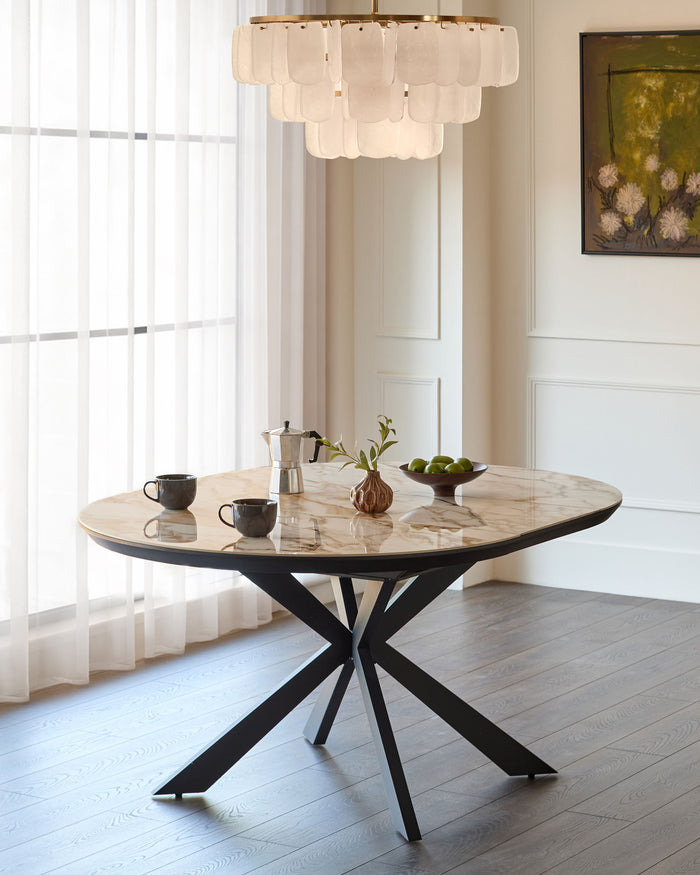
The Hayden natural ceramic extending round dining table uses a smooth butterfly mechanism to extend from a round four-seater to an oval table seating six. The self-storing leaf keeps the everyday profile neat while providing more room when guests arrive.
Internally stored extension leaves
With an internally stored mechanism, the tabletop slides apart to reveal an extension leaf concealed inside the table. The leaf is then lifted into position and secured, creating more surface space without requiring separate storage.
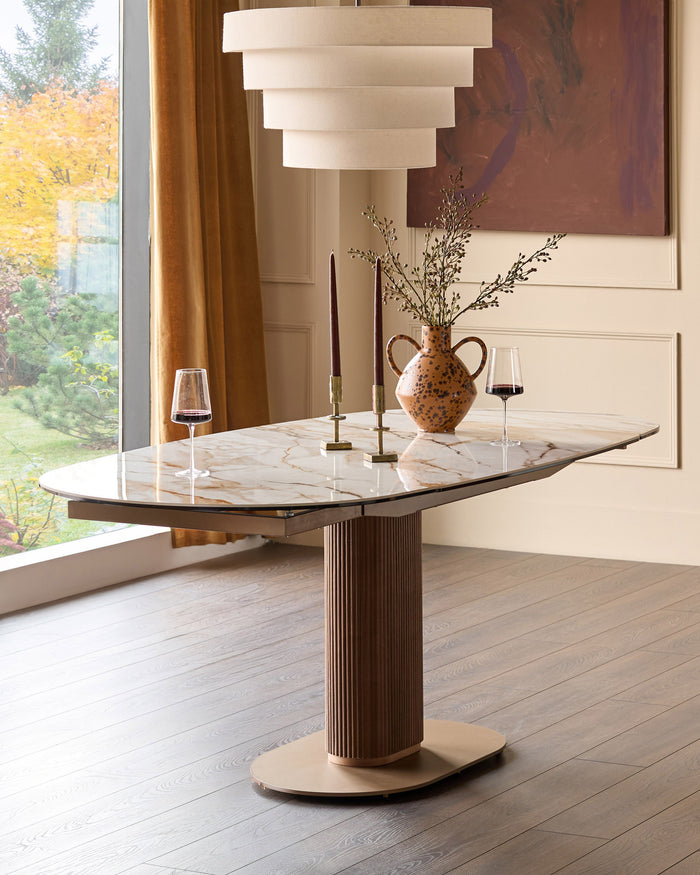
The Hayden white ceramic extending dining table uses a smooth pressure-steel mechanism with a secure clip lock. Its extension stores neatly inside the table, allowing the design to move from eight to ten seats when more room is needed. Internally stored extensions feature throughout the Hayden collection, offering different sizes and finishes for a range of dining spaces.
Externally stored extension leaves
Some extending tables use a completely separate leaf. The two ends of the table pull apart, allowing the additional panel to be positioned in the centre and secured.
Separate leaves can help keep the table’s everyday profile streamlined. However, you will need a suitable place to store them safely when they are not being used.
Double extension leaves
A table with two extension leaves gives you greater flexibility over its length and seating capacity. Depending on the design, you may be able to use one or both leaves, making it easier to adapt the table for gatherings of different sizes.
The Morgan dark wood extending 8–10 seater dining table features a concealed double butterfly mechanism. Its two self-storing leaves fold neatly inside the table when they are not in use, preserving its clean silhouette while providing generous space for larger gatherings.
Lift-up mechanisms
A lift-up mechanism keeps the extension inside the table. As the tabletop slides apart, the concealed panel is lifted into position and secured level with the surrounding surface. This offers the convenience of integrated storage while keeping the mechanism discreet when the table is closed.
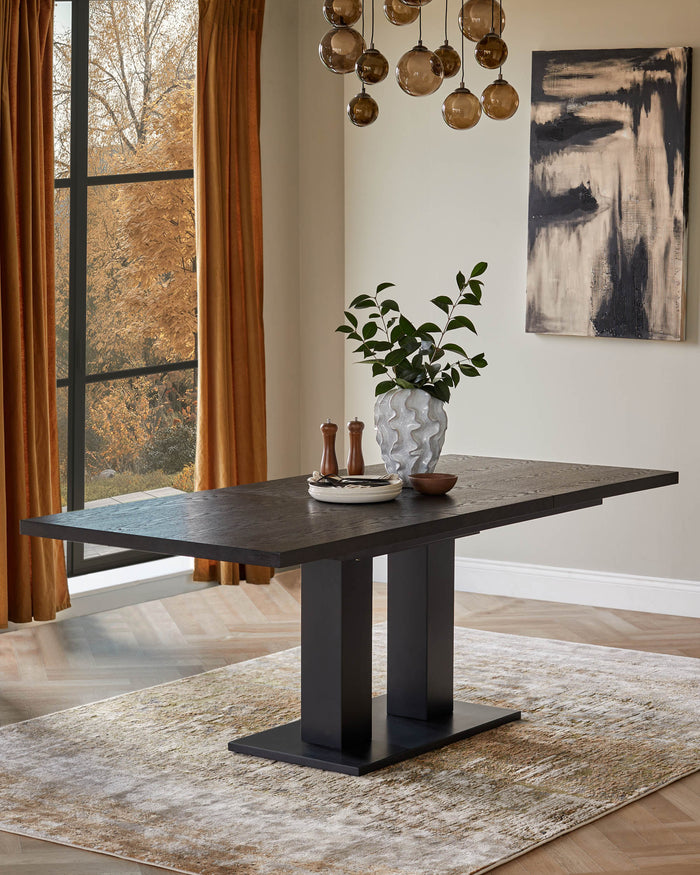
The Morgan dark oak extending dining table features a concealed pressure-steel extension mechanism with a secure clip lock. Its internal leaf allows the table to move smoothly from six to eight seats, while the pedestal base creates generous legroom around the table.

How to Measure for an Extending Dining Table
An extending dining table gives you the flexibility to adapt your space for everyday living and larger gatherings, but it's important to measure for both configurations before you buy.
The closed dimensions tell you how the table will work day to day, while the fully extended measurements help you understand whether there's still enough room for everyone to sit comfortably and move around the space.
Before choosing an extending dining table, check:
- The table's closed length and width
- Its fully extended length and width
- The position of the legs or pedestal base
- How much space chairs need to be pulled out
- Walkways around the table
- Nearby doors, drawers and surrounding furniture
A simple way to visualise the table is by marking its footprint on the floor using masking tape. If possible, position chairs around the outline and pull them out as you normally would. This gives you a much clearer idea of how the table will function in both its everyday and extended positions.
Remember, the table needs to feel just as comfortable when it's fully extended. Guests should be able to sit down, move around the table and access nearby areas without the room feeling cramped.
Measure Your Dining Chairs Too
If you're buying your dining table and chairs together, it's worth checking that both work comfortably as a complete dining set.
Pay particular attention to:
- Overall chair height
- Seat width
- Seat height
- Seat depth
- Back height
- The chair's overall footprint
If you're choosing dining armchairs, don't forget to measure the height of the arms to ensure they'll tuck neatly beneath the table.
Check the Dining Table Measurements
Alongside the overall table dimensions, make sure you also consider:
- Table height
- Closed and extended table length
- Table width
- Inner leg spacing
- The depth of the apron beneath the tabletop, as this can affect legroom and whether certain dining chairs or benches will fit comfortably.
Top Tip: Some extending dining tables store their extension leaves within the table itself, while others require them to be stored separately. It's worth checking which design suits your space before making your decision.
Think Beyond the Measurements
An extending dining table should support the way you live, not just the number of guests you occasionally entertain.
As well as ensuring everyone has enough room to dine comfortably, think about how you'll use the table throughout the week. Will it double as a workspace? Is it where children do homework or creative projects? Does it need to accommodate family celebrations a few times a year?
Choosing a table that works just as well in everyday life as it does for special occasions will ensure it continues to feel practical long after it's arrived in your home.

What size extending dining table do you need?
Start with the number of people who will use the table every day, followed by the maximum number you would like to seat when it is extended.
As a general guide, allow around 60cm of table edge per person. Wider dining chairs, armchairs and generous place settings may require more room, so always compare this guidance with the table’s stated seating capacity and your chosen chair measurements.
The table base also affects how many people can sit comfortably. Pedestal bases can provide greater flexibility because there are fewer legs to work around. With a four-legged table, check the distance between the legs rather than relying on the overall tabletop length.
Which extending table shape is right for your space?
Rectangular extending dining tables
Rectangular tables work particularly well in longer rooms and open-plan spaces. They offer generous surface space and can usually accommodate larger groups when extended.
Their clean proportions also make them easy to position alongside dining benches or a combination of benches and chairs.
Round extending dining tables
A round table creates a sociable setting, allowing everyone to see and speak to one another easily. Its curved profile can also help movement in smaller or square rooms.
Many round tables become oval when extended, maintaining their softer shape while creating additional seating.
Oval extending dining tables
Oval tables combine the generous surface of a rectangular design with softened edges. They can make a larger table feel less imposing and help create a more natural flow through the room.
They are a particularly considered choice for open-plan spaces or rooms where people regularly walk around the table.
Square extending dining tables
Square tables suit square rooms and smaller households, creating a balanced setting for everyday dining. Depending on the mechanism, they may extend into a rectangular table when additional places are needed.
Choosing the right material
The right material depends on your interior style, how frequently the table will be used and the level of maintenance that suits your home.
Ceramic
Ceramic is a considered choice for a hardworking dining space. Its durable surface is resistant to heat and scratches, while its non-porous finish makes everyday cleaning straightforward. Ceramic can also recreate the character of natural stone without requiring the same level of care.
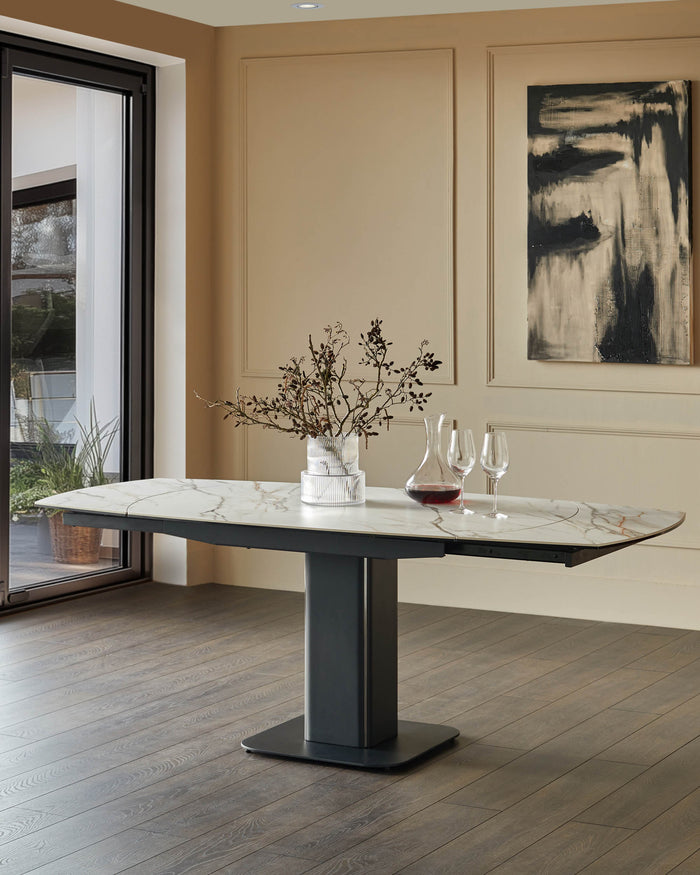
The Fraser natural ceramic extending dining table combines a marble-inspired matt ceramic surface with an innovative rotating extension mechanism. It transforms from a four-seater into a spacious six-seater, while its pedestal base leaves more room for comfortable seating.
Wood
Oak brings natural warmth and lasting character to a dining room. Available in finishes ranging from light, natural tones to dark or black oak, it can complement both understated interiors and more dramatic spaces.
Our collection of oak extending dining tables brings together the character of an oak finish with the flexibility of additional seating. Different sizes and mechanisms make it easier to find a table suited to your everyday routine and the occasions when more people gather.
Use placemats and coasters to protect the surface, clean spills promptly and always follow the care instructions provided with your table.
Glass
Glass can help a dining area feel lighter and more open, making it a useful option in smaller rooms. Clear or smoked finishes create different looks, while the reflective surface complements a wide range of colours and materials.
High-gloss finishes
A gloss finish creates a clean, contemporary look and helps reflect light around the room. Its smooth surface is straightforward to wipe clean, making it a practical option for everyday dining.
The Sanza white gloss extending dining table is finished with three carefully applied, hand-finished layers for a deep and even surface. Its concealed extension mechanism allows it to move from six to eight seats, while the pedestal base maximises legroom for guests.

Pairing an extending table with dining chairs
The right seating should complement the table while fitting comfortably around it in both positions.
Check the width of each chair and measure the usable space between the table legs. Chairs with arms will also need enough clearance to fit beneath the tabletop or apron.
If your table is only occasionally extended, consider where the additional chairs will be kept. Slim or stackable designs can be easier to store, while dining benches offer flexible seating and can often accommodate an extra person when needed.
A ready-made dining set takes much of this planning out of the process. The table and seating have already been considered together, helping you create a cohesive look with comfortable spacing.
How to adjust a misaligned extending table
Over time, an extension leaf may sit slightly higher or lower than the rest of the tabletop. This can usually be corrected by carefully adjusting the mechanism:
- Loosen the adjustable bolts on the extension mechanism.
- Adjust the height of each bolt until it reaches the required level.
- Gently press the extension leaf down until it sits flush against the bolts and level with the tabletop.
- Retighten the bolts securely to hold the extension in position.
Watch our step-by-step video to see the adjustment in action. Always follow the instructions for your specific table and avoid forcing the mechanism.
Extending dining table checklist
Before choosing your table, check:
- The closed and fully extended dimensions
- The everyday and maximum seating capacity
- The space available around the table in both positions
- How much table edge each person will have
- The position of the legs when extended
- Whether your chairs will fit between and beneath the table
- How the extension mechanism operates
- Whether the leaves are internally or externally stored
- Where additional chairs will be kept
- Whether the material suits your everyday needs
- That the table can be delivered safely into the room
Frequently asked questions
Is an extending dining table suitable for everyday use?
Yes. An extending dining table works like a fixed table when closed, giving you a comfortable everyday surface with the option to create more room when needed.
How much space should each person have at a dining table?
Allow approximately 60cm of table edge per person. You may need more for wider chairs, dining armchairs or more generous place settings.
Should I measure the table when it is extended?
Yes. You should measure for both the closed and fully extended positions, including enough room for chairs to be pulled out and for people to walk around the table.
Where are the extension leaves stored?
This depends on the mechanism. Butterfly and some lift-up leaves are stored inside the table, while other designs use separate leaves that must be stored elsewhere.
Are extending dining tables sturdy?
A well-designed extending table should feel secure in both its closed and extended positions. Make sure the leaves are positioned and secured correctly, following the instructions supplied with the table.
Can one person extend a dining table?
Many mechanisms can be operated by one person, although this varies between designs. Check the product instructions or demonstration video before purchasing if ease of use is particularly important.
What shape is best for a small dining room?
Round and oval tables can make movement easier because they have no sharp corners. A pedestal base can also provide more flexible legroom and seating in a compact space.
Can I use a dining bench with an extending table?
Yes. Dining benches can work especially well with extending tables because they offer flexible seating. Check the bench length against the space between the table legs to ensure it will tuck beneath the table where required.
A table designed around real life
The right extending dining table should feel considered in its everyday position and effortless when more room is needed. By measuring carefully and choosing the right size, mechanism, shape and finish, you can create a dining space that adapts naturally - from everyday meals to the moments that bring everyone together.